Story time and reading order, kept apart
Every story has two timelines: the order things happen, and the order readers find out. Asten keeps both, and marks the moments they cross so you can tell a flashback from a slip.
In short
Asten tracks story time (when an event happens in the world) and reading order (when the reader meets it) as two separate clocks. A flashback is not a mistake: Asten argues only inside a run of scenes you declared continuous (CANON-E201), when the dates you gave cannot all be true (CANON-E202), or when an effect is seen before its cause (CANON-E203). Story time can be a day count, a Gregorian date, or a calendar you define.
Story time
When it happens in the world: day 14, 1890-03-02, the winter of 1890, three days after the siege. Day counts, Gregorian dates, or a fictional calendar with your own months.
Reading order
When the reader meets it: chapter 3, scene 2.
CANON-E201 to E203
Story time stepping backward inside a run you declared continuous; dates that cannot all be true; an effect seen before its cause.
CANON-E101
Someone acting after a settled death gets a mark, unless the scene is placed earlier in story time than the death (a flashback), or the mention is a dream, a vision, or something a character says.
Silent until dated
The clocks only compare scenes you’ve placed on both. Undated scenes are never judged.
No timeline required
Draft first. Date scenes when the order starts to matter.
Example: story time inside a continuous run
Reading order · run “The siege”, continuous
- Ch. 8Oren sailsday 14
- Ch. 9The stormday 15
- Ch. 10The harbor burnsday 17
- Ch. 11 · flashback, outside the runMira remembers the fireday 4
- Ch. 12Landfall at Veldday 18
Story time
No scene in the run steps backward in story time. A scene taken out of the run is not compared.
No clock marks.
Why does a story need two clocks?
Narrative theorists call these the fabula (what happened, in order) and the syuzhet (how the telling arranges it). You don’t need the jargon to feel the problem: a flashback is the syuzhet stepping back in the fabula. Done on purpose, it’s craft. Done by accident, it’s a reader frowning at page 212.
Read more in Story time vs. reading order.
What does Asten check, exactly?
- ① Chapter 10: placed at day 17
- ② Chapter 11: placed at day 4
- Set the scene’s time · This scene is not part of the run · Silence this mark · Keep my sentence
Asten compares scenes only inside a run you declared continuous, so an ordinary flashback raises nothing. Give scenes dates, or relative placements such as “three days after the siege”, and Asten solves them together: if no placement satisfies them all, CANON-E202 lists the dates in the knot. If a state is seen before the event that causes it, CANON-E203 says so.
- ① Captain Oren dies (day 9)
- ② Chapter 14 mentions Captain Oren in narration: “Captain Oren”
- ③ Chapter 14: placed at day 14
- Mark the scene as a memory · Set the scene’s time · Move the death later · Silence this mark · Keep my sentence
Why the moon?
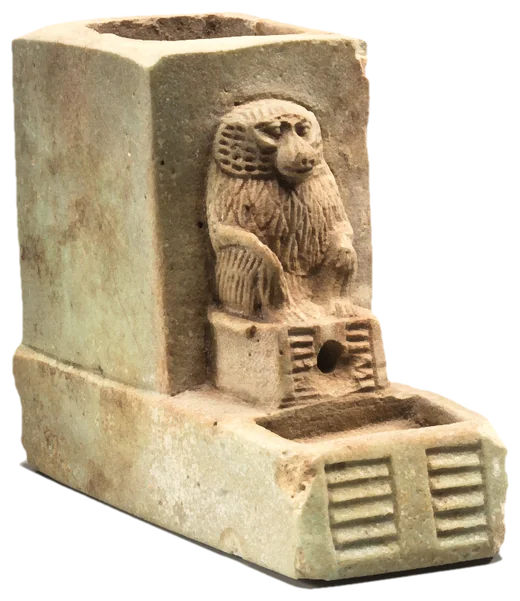
Thoth, the god Asten is named for, was a moon god and the reckoner of time. A story retold by the Greek writer Plutarch tells how Thoth won five extra days from the moon in a game, so that a birth forbidden on every day of the year could happen on days that belonged to no month. A keeper of time who makes room for a story is a fair patron for a timeline.
About two clocks
Does Asten treat every flashback as an error?
Do I have to date every scene in Asten?
Can Asten use a fantasy calendar?
Keep reading
Try the pre-alpha
Open the workbench in your browser on a sample novel, or download release 0.0.1b for Windows or Linux.