Fonts
| Font | Designer and copyright | License |
|---|---|---|
| Fraunces | Undercase Type. © 2020 The Fraunces Project Authors | SIL Open Font License 1.1 |
| Literata | TypeTogether for Google. © 2017 The Literata Project Authors | SIL Open Font License 1.1 |
| IBM Plex Mono | IBM. © 2017 IBM Corp. | SIL Open Font License 1.1 |
| Caveat | Impallari Type, for Google Fonts. © 2014 The Caveat Project Authors | SIL Open Font License 1.1 |
| Noto Sans Egyptian Hieroglyphs | Google. © 2022 The Noto Project Authors | SIL Open Font License 1.1 |
The font files are served from this website, packaged by the Fontsource project. The SIL Open Font License allows fonts to be used, studied, modified, and redistributed freely, as long as they are not sold on their own. Its full text is at openfontlicense.org.
Software
| Software | Copyright | License |
|---|---|---|
| React and React DOM | Meta Platforms, Inc. and affiliates | MIT |
| React Router | React Training LLC, Remix Software Inc., and Shopify Inc. | MIT |
| Vite | VoidZero Inc. and Vite contributors | MIT |
| TypeScript | Microsoft Corporation | Apache License 2.0 |
| Satori | Vercel | Mozilla Public License 2.0 |
| resvg-js | The resvg-js contributors | Mozilla Public License 2.0 |
Satori and resvg-js run only at build time, to render the images shown when a page is shared. They are not sent to your browser.
License texts: MIT, Apache 2.0, and MPL 2.0. Each package also ships its own copy.
In Asten builds
The desk is built on open-source work too. The main components include SQLite (public domain), Tauri (MIT or Apache 2.0), Axum and Tokio (MIT), SQLx (MIT or Apache 2.0), Tiptap and ProseMirror (MIT), and React (MIT). The assistant adds rustls and ring (Apache 2.0, MIT and ISC-style), reqwest (MIT or Apache 2.0), keyring (MIT or Apache 2.0), and the RustCrypto implementations of Argon2 and ChaCha20-Poly1305 (MIT or Apache 2.0). Importing and exporting Word and Open Packaging files uses quick-xml and zip (MIT). This is not a complete list, and each component’s own license applies.
Artwork
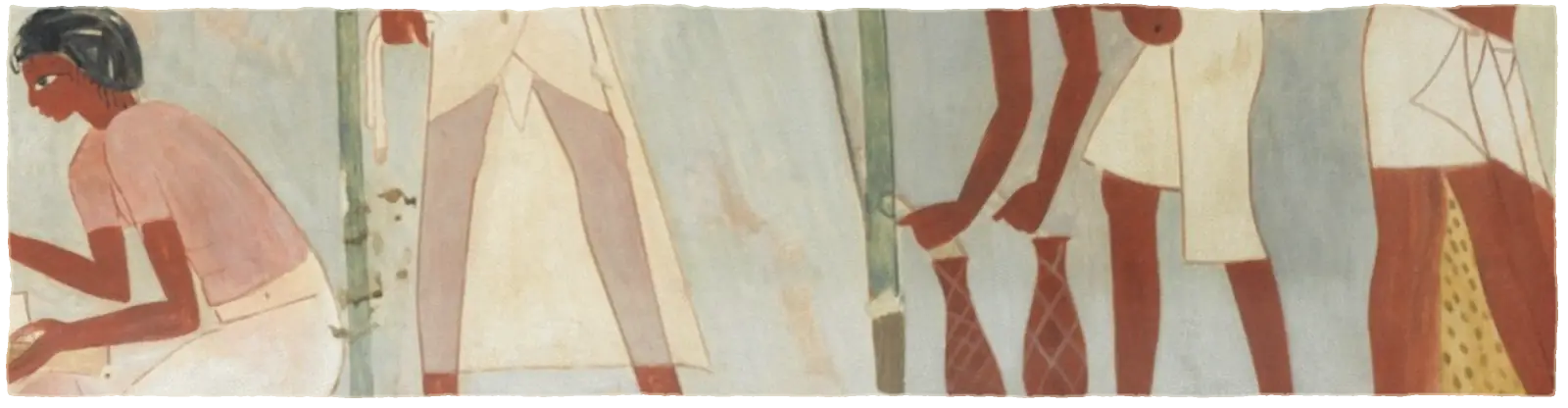
The painted plates on this site are works in the public domain, or images that their holders release under Creative Commons Zero: the Metropolitan Museum of Art (Open Access), the National Gallery of Art, the Cleveland Museum of Art, the Yale Center for British Art and the British Library. The others are old enough that no right remains in them, and the libraries and museums that scanned them make no claim over a faithful photograph. Each is cropped, cut from its backdrop where it is an object, graded to one warm light and set on the paper by Verne; nothing is redrawn or generated. The table gives the holder’s own title, date and object number, and the build that makes the files (art/build.py, with art/works.json and art/plates.json) is in the source repository.
| Work | Holding institution | Licence | Appears on |
|---|---|---|---|
| Harvest Scenes, Tomb of Menna, facsimile by Charles K. Wilkinson, after a tomb painting of about 1396–1347 BCE, 1930, tempera on paper | The Metropolitan Museum of Art, 30.4.44 | Open Access, CC0 | Home, /privacy, /terms and 11 more pages |
| Scribe’s Palette and Brushes, Egyptian, Late Period, 664–332 BCE, wood, ink, reed | The Metropolitan Museum of Art, 14.1.393a–d | Open Access, CC0 | Home |
| The judgement of the dead in the presence of Osiris, from the Book of the Dead of Hunefer, Hunefer, scribe, about 1275 BCE, painted papyrus | The British Museum, EA 9901 (photograph via Wikimedia Commons) | Public domain | Home, /legal |
| Cloud Study (Early Evening), Simon Denis, about 1786–1806, oil on paper | The Metropolitan Museum of Art, 2003.42.18 | Open Access, CC0 | Home |
| Cliffs at Deir el Bahri, Egypt, John Singer Sargent, 1890–91, oil on canvas | The Metropolitan Museum of Art, 50.130.24 | Open Access, CC0 | Home |
| Bronze lamp, Roman, about 4th century CE, bronze | The Metropolitan Museum of Art, 01.17.1 | Open Access, CC0 | Home |
| Haremhab as a Scribe of the King, Egyptian, New Kingdom, about 1328–1314 BCE, granodiorite | The Metropolitan Museum of Art, 23.10.1 | Open Access, CC0 | Home |
| Ibis blanc ou sacré (Ibis religiosa), plate 7 of Histoire naturelle, Oiseaux, after Jules-César Savigny, in the Description de l’Égypte, 1809, engraving | Imprimerie impériale, Paris (scan: New York Public Library, via Wikimedia Commons) | Public domain | Home |
| Astrolabe, Regiomontanus, 1462, copper alloy | The Metropolitan Museum of Art, 2025.347a–j | Open Access, CC0 | /how-it-works |
| Ceiling Decoration, facsimile by Charles K. Wilkinson, after a tomb ceiling of about 1550–1525 BCE, 1924, tempera on paper | The Metropolitan Museum of Art, 30.4.4 | Open Access, CC0 | /features |
| Manuscript Illumination with the Evangelist Luke, Byzantine, late 13th–early 14th century, tempera and gold on parchment | The Metropolitan Museum of Art, 2001.633 | Open Access, CC0 | /features/desk |
| Woman Holding a Balance, Johannes Vermeer, about 1664, oil on canvas | National Gallery of Art, Washington, 1942.9.97 | Open Access, CC0 | /features/canon |
| Portrait of a young woman in red, Egyptian, Roman Period, 90–120 CE, encaustic on limewood with gold leaf | The Metropolitan Museum of Art, 09.181.6 | Open Access, CC0 | /features/cast |
| Water Clock Decorated with a Baboon, Egyptian, Late Period–Ptolemaic Period, 664–30 BCE, faience | The Metropolitan Museum of Art, 17.194.2341 | Open Access, CC0 | /features/time |
| General View of the Island of Philae, Nubia, from Egypt and Nubia, volume I, Louis Haghe, after David Roberts, 1846, tinted lithograph | The Cleveland Museum of Art, 2012.259 | Open Access, CC0 | /features/world |
| Two men threshing a sheaf, margin of the Luttrell Psalter, folio 74 verso, English illuminator, about 1325–35, tempera and gold on parchment | The British Library, Add MS 42130 | Open Access, CC0 | /features/compiler |
| Pocket set of drawing instruments, Peter Dollond, about 1755–60, shagreen case with silver mounts; brass, steel and ivory instruments | The Metropolitan Museum of Art, 41.160.67a–l | Open Access, CC0 | /features/packs |
| Portrait of a man with a mole on his nose, Egyptian, Roman Period, 130–150 CE, encaustic on limewood | The Metropolitan Museum of Art, 09.181.2 | Open Access, CC0 | /features/word-and-google-docs |
| Interior with Young Woman from Behind, Vilhelm Hammershøi, 1904, oil on canvas | Randers Kunstmuseum (photograph via Wikimedia Commons) | Public domain | /features/local-first |
| Still Life with a Skull and a Writing Quill, Pieter Claesz, 1628, oil on wood | The Metropolitan Museum of Art, 49.107 | Open Access, CC0 | /ai |
| A Lady Writing, Johannes Vermeer, about 1665, oil on canvas | National Gallery of Art, Washington, 1962.10.1 | Open Access, CC0 | /for/novelists |
| Atlas sheet from the Description de l’Égypte, after Pierre Jacotin and the Commission des sciences et des arts d’Égypte, about 1800, engraved map | scan: Heidelberg University Library, via Wikimedia Commons | Public domain | /for/worldbuilders |
| The Dance Class, Edgar Degas, 1874, oil on canvas | The Metropolitan Museum of Art, 1987.47.1 | Open Access, CC0 | /for/screenwriters |
| Lisbeth Reading, Carl Larsson, 1904, watercolour, charcoal and tempera on paper mounted on canvas | Nationalmuseum, Stockholm, NMB 2342 | Public domain | /for/fan-fiction |
| Barges at Pontoise, Camille Pissarro, 1876, oil on canvas | The Metropolitan Museum of Art, 1979.135.16 | Open Access, CC0 | /for/ai-tinkerers |
| Melencolia I, Albrecht Dürer, 1514, engraving | The Metropolitan Museum of Art, 19.73.85 | Open Access, CC0 | /guide |
| The Moneylender and His Wife (detail), Quinten Metsys, 1514, oil on wood | Musée du Louvre (reproduction: Web Gallery of Art, via Wikimedia Commons) | Public domain | /compare |
| The Garden of the Tuileries on a Spring Morning, Camille Pissarro, 1899, oil on canvas | The Metropolitan Museum of Art, 1992.103.3 | Open Access, CC0 | /download |
| The Road from Versailles to Louveciennes, Alfred Sisley, probably 1879, oil on canvas | The Metropolitan Museum of Art, 64.154.2 | Open Access, CC0 | /roadmap |
| Cyperus papyrus L. (Papyrus Sedge): finished drawing of inflorescence, James Bruce, 18th century, watercolour and gouache over graphite on paper | Yale Center for British Art, B1977.14.9119 | Open Access, CC0 | /journal |
| The Bookworm, Carl Spitzweg, about 1850, oil on canvas | Museum Georg Schäfer, Schweinfurt (photograph via Wikimedia Commons) | Public domain | /journal/ai-editor-not-writer |
| The Boulevard Montmartre on a Winter Morning, Camille Pissarro, 1897, oil on canvas | The Metropolitan Museum of Art, 60.174 | Open Access, CC0 | /journal/continuity-in-a-long-novel |
| Portable diptych sundial, Hans Tröschel the Elder, about 1598, ivory, brass | The Metropolitan Museum of Art, 03.21.38 | Open Access, CC0 | /journal/story-time-and-reading-order |
| Miniature Relief of a Saint Luke at His Writing Table, German, 1200–1225, wood, polychromy, gilding | The Metropolitan Museum of Art, 41.190.237 | Open Access, CC0 | /journal/do-you-need-a-story-bible |
| The Bedroom, Vincent van Gogh, 1889, oil on canvas | The Art Institute of Chicago, 1926.417 | Public domain | /journal/local-first-writing |
| Glossy Ibis, plate 387 of The Birds of America, John James Audubon, 1827–38, hand-coloured aquatint and engraving | scan: University of Pittsburgh, via Wikimedia Commons | Public domain | /glossary |
| Portrait of the Boy Eutyches, Egyptian, Roman Period, 100–150 CE, encaustic on wood | The Metropolitan Museum of Art, 18.9.2 | Open Access, CC0 | /faq |
| Thot Ibiocéphale (Dieu des Lettres) à Philae, Maxime Du Camp, April 1850, salted paper print from a paper negative | The Metropolitan Museum of Art, 2005.100.376.117 | Open Access, CC0 | /name |
| Morning, An Overcast Day, Rouen, Camille Pissarro, 1896, oil on canvas | The Metropolitan Museum of Art, 1980.21.1 | Open Access, CC0 | /about |
| Portrait of an elderly lady with a gold wreath, Egyptian, Roman Period, 100–125 CE, encaustic on limewood | The Metropolitan Museum of Art, 09.181.5 | Open Access, CC0 | /contact |
| Inkwell, Egyptian, Middle Kingdom, about 2051–1981 BCE, wood | The Metropolitan Museum of Art, 31.3.59 | Open Access, CC0 | /brand |
| Cloud study, John Constable, 1830–35, watercolor over graphite | The Metropolitan Museum of Art, 2016.589 | Open Access, CC0 | /404 |
| Sunset Sky, John Frederick Kensett, 1872, oil on canvas | The Metropolitan Museum of Art, 74.30 | Open Access, CC0 | Home |
The ornaments, icons, friezes and diagrams are original SVG drawings by Verne. See copyright for how everything on this site may be used.
Hieroglyphs and the cartouche toy
Where this site refers to a hieroglyph by code, the code follows Gardiner’s sign list, the standard catalog from Sir Alan Gardiner’s Egyptian Grammar. G26, for example, is the sacred ibis on a standard, the sign of Thoth.
Questions about this page? Write to info@vernesystems.com. All policies: Legal.